
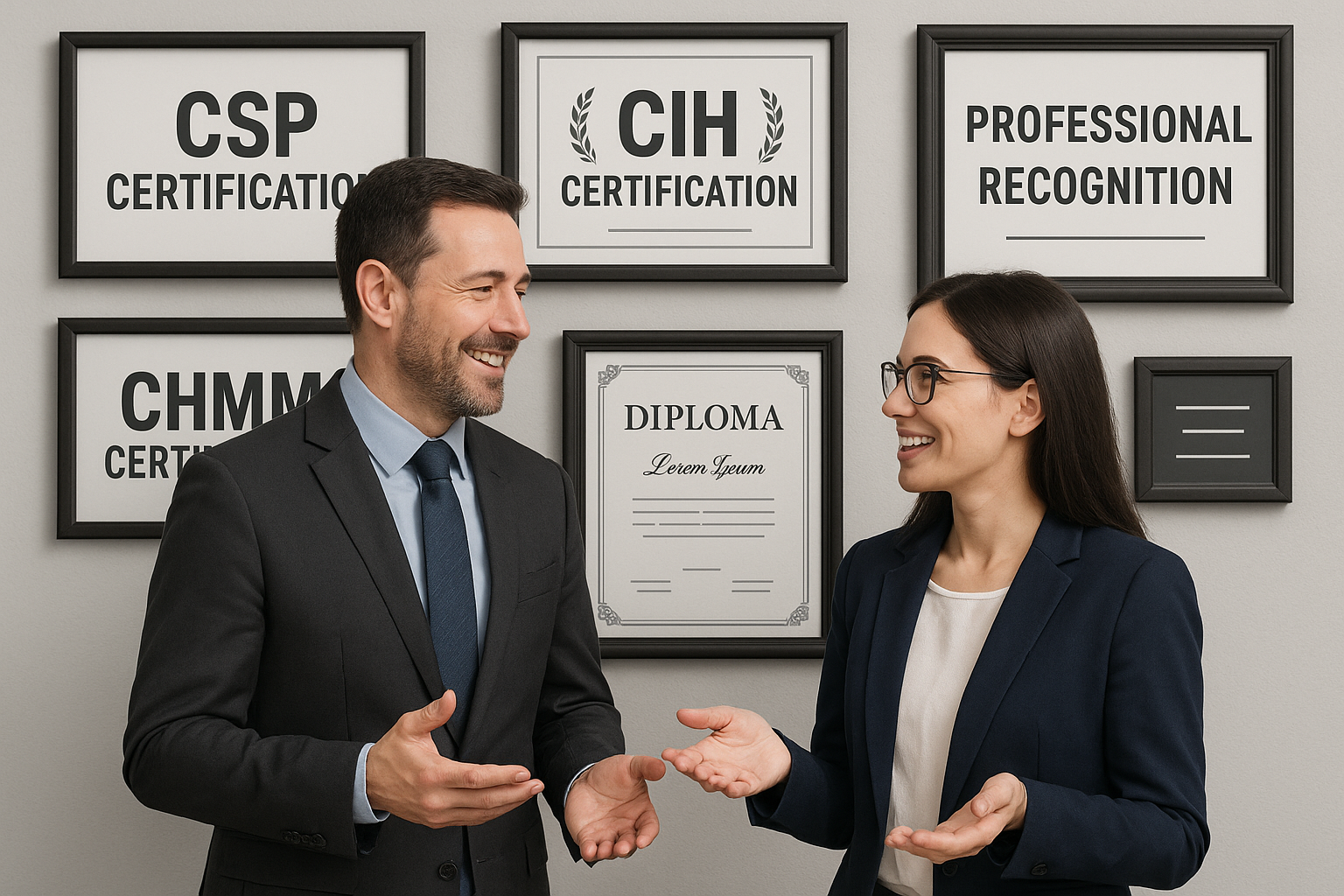
Thinking about EHS Certifications?
If you’re asking yourself, “What should be my next certification?” — you’re not alone. This is one of the most common questions I get from EHS professionals at all levels.
But here’s the truth: there’s no one-size-fits-all answer.
The right certification for you depends on your industry, role, goals, experience level, and even your dream job. Are you in construction? Manufacturing? Environmental consulting? Oil & gas? Are you aiming for a corporate role, or leading field operations? These questions matter.
So, no — I’m not here to prescribe a magic formula. Instead, I want to offer a perspective based on my personal journey, what worked for me, and what I’ve seen work for others over 20+ years in the field.
1) Start With What’s Required of You
Before chasing a new title or acronym, start with this foundational question:
What does the law, your company, your client, or your industry expect from an EHS professional?
In many countries, regulations require a specific level of academic or technical preparation for someone to be designated as the H&S responsible party. In others, it’s left up to the employer — which is how many professionals transition from engineering, maintenance, or operations into EHS roles.
If that’s your path — growing into EHS through field experience — congratulations: you’re already learning the most valuable part of the job — real-world risk. Now it’s time to build on that foundation.
2) My Take on Safety Degrees
Today, you’ll find plenty of universities offering degrees in Occupational Health & Safety, Environmental Science, or Industrial Hygiene. Some fully online — like those from Columbia Southern University or Arkansas State University.
If your first degree wasn’t in EHS, a master’s in occupational safety, Public Health, or Industrial Hygiene could be your strategic next move — especially if you’re eyeing higher-level roles or certifications that require a graduate degree.
3) Building Your EHS Career from the Ground Up
If you’re still early on your journey, start with the basics:
- OSHA 10/30-Hour Training (Construction or General Industry)
- Read and understand OSHA 1910 and 1926 standards
- Learn your facility’s compliance drivers: SWPPP, SPCC, RCRA, DOT, Tier II, TRI, etc.
The truth? Mastering compliance topics will immediately boost your value. The more versatile you are — the more doors open.
If you’re looking for a future goal, consider becoming an Authorized OSHA Trainer (OSHA 500/501). It’s not just a certificate — it’s a credibility booster and comes packed with expertise and networking.
4) The Certifications That Made a Difference for Me
After years of experience, I earned three certifications that significantly elevated my career:
First the CSP – Certified Safety Professional
Offered by the Board of Certified Safety Professionals (BCSP)
💡 Recognized as the gold standard in safety certification.
Why I chose it: Employers value field safety experience + CSP. It opened doors to global construction and corporate EHS leadership.
Second the CIH – Certified Industrial Hygienist
Offered by the Board of Global Credentialing (BGC)
💡 CIHs are highly respected across industries for deep technical expertise.
Why I chose it: My college industrial hygiene background wasn’t well enough known without the credential. This one helped solidify my credibility in advanced roles. (up to here, I was a CSP + CIH)
Third the CHMM – Certified Hazardous Materials Manager
Offered by the Institute of Hazardous Materials Management (IHMM)
💡 The only certification recognized by the EPA under 40 CFR §312.10
Why I chose it: I needed to validate my knowledge in environmental compliance — this one covered RCRA, CAA, CWA, DOT, and more.
⚠️ Note: These certifications are not entry-level. They require years of experience, rigorous exams, and ongoing recertification.
One way to see this is EHS, CHMM for the “E”, CIH for the “H” and CSP for the “S” and for the Leadership and Management.
5) Other Valuable Certifications to Consider
Not every certification has to be a mountain. Here are others that can build your skillset and leadership value:
- OSHA 500/501 Trainer Authorization
- First Aid / CPR / AED Instructor
- Root Cause Analysis Certifications (TapRoot, ICAM, Apollo, etc.)
- ISO 45001 and 14000 or Internal Auditor Certifications
- Environmental Compliance Courses (e.g., air permitting, stormwater, SPCC)
- Leadership or Coaching Certifications (great for managers and aspiring leaders)
Let me be clear: Certifications won’t teach you the job.
They validate what you already know — or what you’re willing to work hard to learn. That means study, practice, and dedication. But with the right focus, certifications become more than credentials — they become career accelerators.
6) So… What’s Next for You?
Your next certificate should align with one (or more) of these questions:
- What gap do I need to close?
- What role do I want to be qualified for?
- What problem do I want to solve better?
- What would make me stand out in the next promotion or interview?
You don’t need them all. But the right certification, at the right time, for the right reason — can be a game-changer.
What isyour next move?

If you want to advance your career, then book your Growth Strategy Call now.